How to Check a Tokunbo Car's History With Its VIN Before You Pay
By Cee · 17 November 2026 · 5 min read

To check a tokunbo car's history, take the 17-character VIN from the car itself, run it through a vehicle history service that uses official US records, and read the report for title brands, mileage and damage before you pay a deposit. Most foreign-used cars sold in Nigeria came from the United States, where a car's title, auctions and insurance claims leave a paper trail. That trail is what tells you whether the clean-looking car in front of you was flooded, crashed or had its mileage rolled back.
This guide explains how to do it step by step, what each part of a report means, and the checks a report can't replace. Disclosure: we built TokunboVerify, one of the services that does this, and Cee is the company's COO; the case study explains our role. The steps below work whichever service you use.
Why the history matters
A car can look perfect after a good panel beater and a deep clean. What you can't see is whether it was declared a total loss in the US, sat in flood water, or had its odometer reduced before export. These problems show up in records long before they show up on the road. Flood damage in particular can affect a car's electrics and mechanics for years, as the US road safety agency NHTSA has warned.
Checking the history doesn't guarantee a good car. It removes the worst surprises and gives you facts to negotiate with or a reason to walk away.
Step 1: Find the VIN on the car, not the papers
The Vehicle Identification Number is 17 characters long and never uses the letters I, O or Q, which avoids confusion with 1 and 0. You will usually find it:
- On a small plate at the base of the windscreen, on the driver's side, visible from outside.
- On a sticker in the driver's door frame.
- On the vehicle's papers and, often, stamped on the engine bay.
Read it from the car itself and check it matches the papers. A VIN that differs between the windscreen, the door and the documents is a serious warning sign on its own. You can confirm the number decodes to the right make, model and year with the free NHTSA VIN decoder.
Step 2: Run the VIN through official records
In the US, the National Motor Vehicle Title Information System (NMVTIS), overseen by the Department of Justice, collects title and brand information that states, insurers, junk and salvage yards are required to report. Consumers can get NMVTIS reports through approved providers. A good history service will combine NMVTIS data with auction and insurance records.
TokunboVerify, for example, checks NMVTIS, auction records and insurance history, then uses an AI layer called "Oga Mechanic" to explain the risks in plain language. There is also a free check from the US National Insurance Crime Bureau, NICB VINCheck, which shows whether participating insurers reported the car as stolen and unrecovered or as salvage. It is useful, but narrow: it doesn't cover mileage or full title history.
Step 3: Read the report properly
Look for these items, in this order:
- Title brands. Words like "salvage", "flood", "rebuilt" or "junk" mean the car was badly damaged or written off at some point.
- Mileage history. Each recorded odometer reading should be higher than the last. A reading that goes down, or a dashboard showing far fewer miles than the last record, suggests the mileage was rolled back.
- Auction records and photos. Pre-export auction photos show the car before it was repaired. A car that looks perfect now but was photographed crushed at the front tells you what the repair covered up.
- Insurance and total-loss records. These show whether an insurer paid out on the car as a write-off.
- Location history. A car that was registered in an area hit by a major flood, then sold quickly, deserves a closer look.
A report with no problems is good news, not a sign that the check failed. Most cars have ordinary histories.
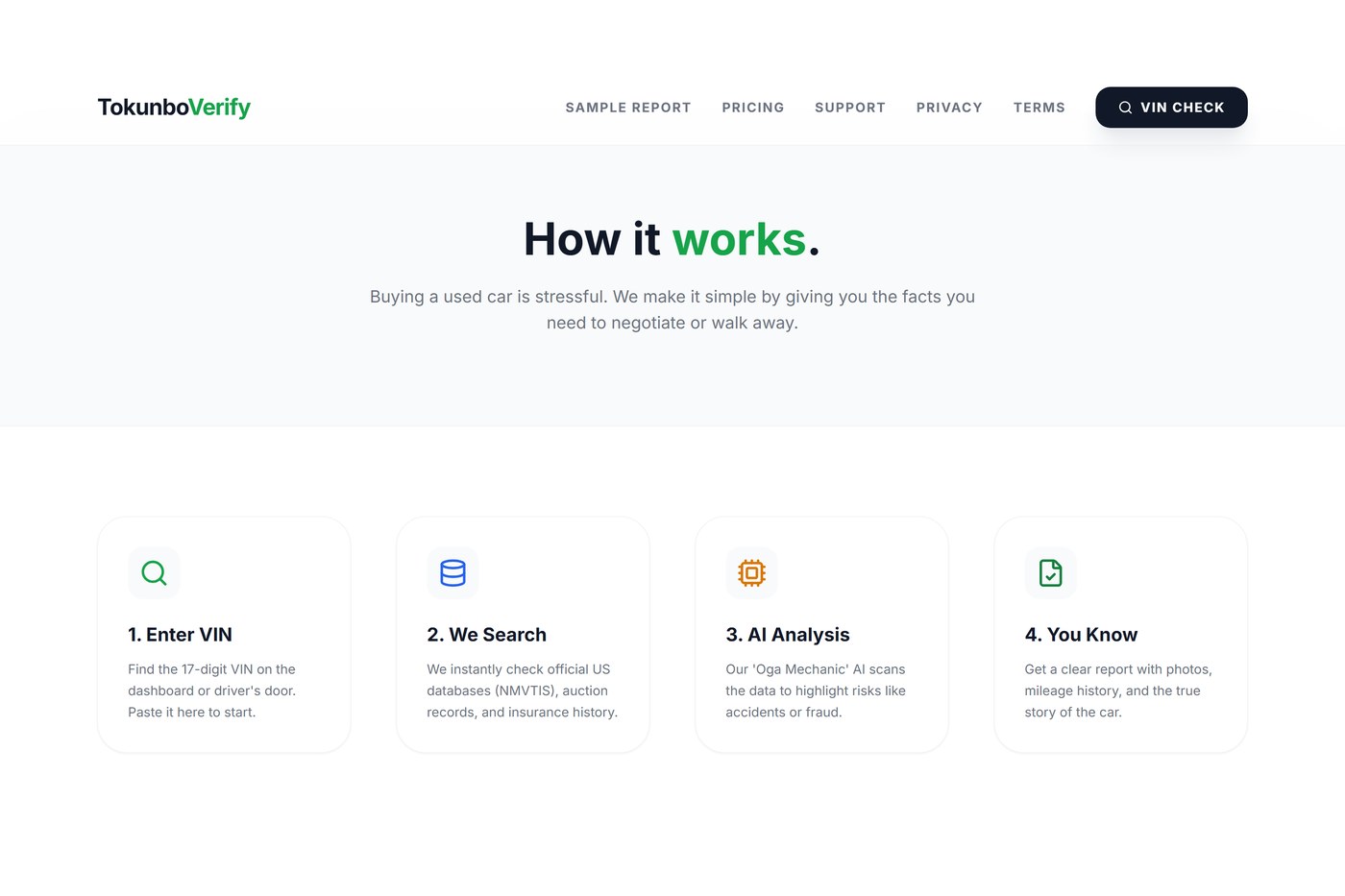 TokunboVerify's four steps: enter the VIN, search the records, AI analysis, then the report. | Screenshot: tokunboverify.com, 13 November 2026
Step 4: Check the car in person anyway
A history report is not a mechanical inspection. NMVTIS itself says its reports don't replace an independent inspection. Before paying, have a trusted mechanic check the car, and look for the physical signs of flood damage: a musty smell, rust under the seats or on bolts, moisture in the lights and electrical faults. Our separate guide to spotting flood-damaged and salvage cars covers these signs in detail. For background on why proof matters so much in a purchase like this, see our post on trust signals that make customers pay online.
Step 5: Use what you find
If the report is clean and the inspection is good, you can buy with more confidence. If the report shows a problem, you have three choices: walk away, negotiate a lower price with the evidence in hand, or ask the seller to explain. A seller who becomes angry when you mention a VIN check is telling you something.
Common mistakes
- Checking after paying a deposit. Run the VIN before any money changes hands.
- Using a VIN the seller typed for you. Copy it from the car yourself.
- Relying on one source. Combine a history report with a physical inspection.
- Ignoring small warnings. One gap in the mileage record may be innocent; a pattern rarely is.
What this means for buyers
Our view, offered as analysis: for a purchase this large, a history check is one of the cheapest forms of protection available. It doesn't replace a mechanic or common sense, but it changes the conversation with the seller from trust to evidence.
Where Omenala fits
We built TokunboVerify from the first line of code, including the report, the payments and the dealer bundles, and we help run it today. Our case study tells the full story. If your business needs a platform that turns complicated data into something customers can act on, tell us about it.
In short
Copy the VIN from the car, run it through official records, read the title brands and mileage first, then get a mechanic to inspect the car before you pay.
This article contains analysis and opinion based on publicly available information. It is not legal or financial advice. Readers are encouraged to consult primary sources and form independent conclusions.